RM MARKETING SERVICES
  • Home
  • Ideas for Publishers
  • Blog
  • About us
  • Contact us

How to Find the Hook in Your Book

28/7/2025

0 Comments

 
Picture

How to Find the Hook in Your Book: A Practical Guide to Pitching and Promoting Your Book with Help from AI

Whether you’re an author, publicist or small publisher trying to get media attention for a book, it all starts with one thing: the hook.

Let’s be honest: not every book is going to get a feature in Good Weekend or land a primetime radio interview. Media outlets aren’t hanging around waiting for your press release to drop. They’re looking for stories—and not just any stories, but ones that hit a nerve, tap into the cultural mood, offer a surprising insight, or speak to a news moment already on the boil.

So how do you make sure your pitch doesn’t fall flat? And how do you find the hook in your book—the one that makes a journalist pause and say, “Hmm, there’s something here”?

Let’s talk about developing a great pitch, making your book matter, and using tools like ChatGPT to help you dig into the angles that media actually want.

Why Your Pitch Might Be Failing (Don’t Take It Personally)

First, the truth: most book pitches to media fail. Not because the book is bad, but because:
  • The hook’s not strong enough
  • The pitch doesn’t connect to current conversations
  • It sounds like an ad, not a story
  • It’s too generic, too niche, or just not timely

The good news? All of this is fixable. But only if you stop thinking like a marketer and start thinking like a journalist.

What Is a Hook Anyway?

The hook is not your book’s topic. It’s the angle that makes it interesting now. It’s what makes your story part of a bigger conversation or controversy.

It’s “Women over 50 quitting corporate life to start again” — not “memoir about leaving my job.”
It’s “how Aussie men are learning to talk about grief” — not “book about losing my dad.”
It’s “what burnout really means for high-functioning execs” — not “leadership and wellbeing tips.”
The hook gets you in the door. Your book can come later.

Types of Hooks That Work (Especially in Australia)

Journalists and producers want ideas that plug into bigger issues, including:
  • Timely news links (economic downturns, climate anxiety, cultural moments)
  • Social issues (mental health, gender equity, multicultural identity, housing)
  • Personal stories that reflect wider challenges
  • First-person insight or expertise on something topical
  • Contrarian takes (“Why remote work is making us miserable” etc.)
  • Visual, quirky or unusual stories for TV or digital
  • Seasonal or event tie-ins (Christmas lists, school holidays, awareness weeks)
If your book touches on any of these, there’s your door.

Using ChatGPT to Find Your Angle
Let’s say you’re stuck. You know your book has something valuable to say, but you’re not sure how to shape it into a story that media will care about.

Here are three ChatGPT prompts to help:

Prompt 1:

“Act like an Australian journalist. What are five current media angles or headlines that could be inspired by this book: [insert short book description here]?”
→ This gives you potential hooks based on current media trends.

Prompt 2:

“What are some talking points from this book that link to current issues in Australian society?”
→ Great for tying your book to newsworthy themes.

Prompt 3:

“I’m pitching a non-fiction book to ABC Radio. Give me five segment ideas or interview titles that would make a compelling on-air discussion.”
→ This can help you shape your pitch their way, not yours.
You can also ask ChatGPT to roleplay a hostile producer and see where your pitch falls flat. It’s confronting—but helpful.

Developing Talking Points that Stick
Once you’ve got your hook, it’s time to nail your talking points. These aren’t summaries of your book. They’re short, sharp, quotable insights that show:
  • Why this topic
  • Why now
  • Why you
If you’ve written a memoir, pull out the wider social commentary. If you’ve written about leadership, say what’s changing right now for leaders. If your novel reflects real-world trauma, connect it to something we’re seeing in the news.

And please, don’t just say “this book is for everyone.” It’s not. Be specific.

What Media Actually Want
Producers and editors aren’t doing you a favour. They need good stories that speak to their audience. You’re there to help them do their job. Respect that.

Your job is to:
  • Pitch them a story
  • Show why their audience will care
  • Be ready with clear messaging, interview skills, and supporting content
  • Follow up once, then leave it alone (they are under-resourced and drowning in emails)

The Hook is Your Key. Don’t Pitch Without It.
If you haven’t found the hook, don’t send the pitch yet. You’ll burn the contact and waste your shot. Use AI to help you dig deeper. Ask colleagues. Ask a friend who listens to the ABC religiously.

And yes, ask AI. It's a godsend for these sort of tasks. And even as a highly experienced marketer, ChatGPT and I are BFFs when it comes to this sort of stuff. Don't be afraid of it. Utilise it and embrace it.

Struggling to Pitch Fiction, Poetry or Children’s Books?
Still having problems with it? That’s okay.

Not every book lends itself easily to a media hook—particularly fiction, poetry, or children's books. The news angle might be light, the themes subtle, or the author unknown. In those cases, you might need to pivot the pitch: focus on a personal story, a unique setting, a writing journey, or even the book’s visual appeal. Sometimes, the best you can do is make it charming, brief, and well-timed.

For example, a children’s book on kindness might connect to World Kindness Day or school wellbeing programs. A novel set in a fictional coastal town could draw on the author’s regional ties or inspire a travel feature.

And yes, there are times when publicists will pitch without a strong hook—because the author is Elizabeth Gilbert, or Sarah J. Maas has just breathed in a different direction and the fandom’s in meltdown. In those cases, media want the story before you even send the email.

But for the rest of us, it pays to do the work—especially for non-fiction.

The hook still matters. Even when it’s not obvious.

RM Marketing Services provides outsourced marketing, sales and consulting support to publishers, distributors, and other organisations across the book industry.

Authors can also book a one-hour consultation for practical, professional advice on every aspect of book marketing and sales—from advertising and campaign planning to digital strategy, websites, social media, publicity, and events. We offer discounted options for referrals and pre-payment of 5+ sessions.

Take advantage of Rachael McDiarmid’s 35+ years of experience in publishing sales, marketing and management today! 

​Contact us to find out more.
0 Comments

WHAT PUBLICITY DO YOU HAVE PLANNED?

7/7/2025

0 Comments

 
Picture

Why Publicity Isn’t the Only Question Distributors Should Be Asking
​(And What Authors Should Be Ready For)

If you’ve tried to get your book into distribution—whether through a trade distributor, library supplier, or aggregator—you’ll know this question by heart:

“What publicity do you have planned?”

It’s a question that, frankly, drives many publishers and authors to distraction.

Yes, publicity is important. But it’s also one of the most unpredictable and least controllable aspects of any marketing plan. Even well-funded, carefully crafted campaigns can be knocked sideways when news cycles shift, review editors are overwhelmed, or your topic simply isn’t in the spotlight. Meanwhile, the success of a book depends on much more than whether you can secure a handful of media mentions.

Why This Narrow Focus on Publicity Falls Short
Here’s why this question is becoming outdated:
  • Publicity is just one part of the equation. A complete marketing plan also includes advertising, social media, events, partnerships, retailer engagement, special sales, and more. When distributors only ask about media coverage, they ignore the many ways books actually find their readers.
  • Most books don’t get widespread traditional media coverage. Thousands of new titles are released every month in Australia alone. Only a fraction will be reviewed in major outlets. A fixation on mainstream reviews overlooks the reality of a crowded market.
  • Publicity doesn’t guarantee sales. Even glowing coverage sometimes fails to translate into purchases—especially without clear calls to action, retailer support, or a strong online presence.
  • Other factors often matter more. Distributors often don’t ask about the author’s network, any niche audiences, or whether the publisher has a strategy for special sales—yet these can drive much of a book’s success.

Start With a Clear, Holistic Plan

Before you even think about pitching distributors, it’s worth stepping back and thinking carefully about all the factors that drive demand.

One of the most effective ways to do this is by answering practical questions about your book, your readers, and your goals. For example:
  • Who exactly is this book for? What groups, professions, or communities will care?
  • Are there special sales opportunities—bulk orders, associations, conferences, or corporate gifts?
  • Do you have an author platform—social media, newsletter, website—that can support discovery?
  • What comparable titles have sold well, and how are you positioned against them?
  • What marketing activities beyond publicity will you use to generate awareness?
  • What formats are you offering, and what sales channels will you pursue?

This process isn’t just about marketing—it’s about clarity. The more you know about where your sales are likely to come from, the more realistic and effective your plan will be.

Before you start imagining bestseller lists, spend some time understanding the actual sales data for your genre. Knowing what’s realistic helps you set achievable goals and focus your energy on strategies with the highest chance of success.

Why Sales Strategy Deserves as Much Attention as Publicity
One reason this publicity question can be so frustrating is that it implies media mentions alone drive success. In reality, many books don’t primarily sell through retail bookshops or thanks to reviews.

Books are also sold:
  • Direct from the author’s website  
  • As incentives, gifts, or in bulk to organisations
  • At conferences, events, or professional gatherings
  • Through speaking engagements and workshops
  • To libraries and institutional buyers (although preference for them is to buy from a distributor)
  • To specialist audiences that traditional media rarely reaches

If your distributor only wants to hear about newspaper coverage but isn’t interested in how you’ll reach niche buyers or drive direct sales, they’re missing a huge part of the picture. 

It’s also worth remembering: most books—especially in Australia’s relatively small market—sell in modest quantities. Even with a fantastic marketing plan, success takes time, patience, and consistent effort.

What You Can Control (And What You Can’t)
One reason it helps to think beyond publicity is that media coverage is inherently unpredictable. No matter how strong your pitch, you can’t guarantee an editor will pick up your story.

But you can control:
  • How you position your book in the market
  • The quality of your metadata and online listings
  • Your pricing, formats, and availability
  • Your advertising and social media strategy
  • The relationships you build with communities and organisations
  • Your direct sales and email marketing efforts
Publicity is wonderful when it comes—but it’s just one part of the mix.

A Final Thought
Distributors asking about publicity isn’t going away anytime soon. But by broadening the conversation—and coming prepared with a well-rounded marketing and sales strategy—you’ll be in a much stronger position to show your book’s potential.

Publishing is a demanding business, and the landscape is only getting more crowded. But if you approach it with clear-eyed realism, creativity, and persistence, you’re far better placed to make your work stand out. 

​Focus on what you can influence, stay realistic about the challenges, and remember: a professional approach and a multi-layered strategy will always take you further than relying on luck and a newspaper clipping.
0 Comments

GETTING NOTICED: A PUBLICITY PRIMER FOR INDIE AUTHORS & SMALL PRESSES

13/6/2025

0 Comments

 
Picture
Publicity — not to be confused with advertising or marketing — is about earned media. It’s the process of securing attention through news coverage, interviews, reviews, profiles, and event appearances. For traditionally published authors, a publicist often takes care of this. For indie authors, publicity is frequently a DIY effort — but that doesn’t mean it’s out of reach.

Start with Strategy — Not a Scattergun Approach
One of the most common mistakes I see is authors jumping straight into action: “I sent my book to 50 outlets but didn’t get any replies!” The problem is rarely the book — it’s usually the lack of targeting.

Before you even think about sending a media release or pitching an interview, pause and consider:
  • Who is the audience for your book?
  • What media does that audience consume?
  • What topics or trends might make your book timely or relevant?

Build a shortlist of media outlets that genuinely reach the audience you want. It’s better to send ten well-researched, relevant pitches than a hundred generic ones.

Know What Journalists and Producers Actually Want

Media professionals are busy and under pressure to find content quickly. Your pitch — in the form of a media release attached to an email — needs to be easy to understand, timely, and relevant.

They don’t have time to read the full book. So you need to distil the story down to its strongest, most compelling element. Ask yourself: if this book were a news segment or feature article, what would the headline be? Why would this author’s perspective interest their readers or viewers right now?

Think beyond the book itself. Sometimes the author’s personal story, research journey, or area of expertise is the hook.

Write a Professional Media Release

A media release is a summary of the book’s newsworthiness. It’s not a sales blurb or back cover copy. It should clearly explain what the book is about, who the author is, why it matters, and how to get in contact. 

Include:
​
  • A sharp, informative headline
  • One to two paragraphs outlining the key themes or story
  • Author background (and why they’re relevant to the subject)
  • Key publication details (release date, ISBN, availability)
  • A short quote (from the author or an endorser)
  • Contact information and a link to the book’s webpage or press kit
  • And yes — spelling, grammar, and formatting count. This is a professional pitch, not a casual message.

Don’t Forget the Extract

When pitching media, always have a short extract or sample available. This could be the first chapter or a key passage that captures the tone and themes. It’s a useful attachment for reviewers and a way for journalists to get a quick feel for the book without committing to a full read.

Lead Times Matter

One of the most important aspects of publicity that often catches indie authors off guard is lead time. Most media outlets work well in advance, especially for print and high-profile placements. Glossy magazines and special interest journals can require three to four months’ notice, while major newspapers and national broadcast programs often need two to three months. Even radio segments — particularly those covering books — usually require at least a month’s lead time to secure a spot.

The same goes for high-profile podcasts, especially those featuring bestselling authors or working closely with major publishers. Literary festivals, library events, and in-conversation appearances also require early planning, with some programming as far as six to twelve months ahead.

To manage this effectively, your publicity campaign should be staggered. Start early with long-lead media and event pitches, then shift focus to shorter-lead opportunities (such as online media, newsletters, and social content) closer to the publication date. If you leave everything until launch week, you’ll likely miss key windows of opportunity.

That said, if your book is especially newsworthy — or if you tap into a fast-moving media moment — timelines can shift rapidly. In some cases, you might become the story!

Build a Media List You Can Actually Use

Many indie authors don’t have access to the media databases that large publishers do — and that’s fine. You can still develop your own list by:

  • Looking at who covers books similar to yours
  • Reviewing author acknowledgements or media mentions
  • Using free resources from your State Library or Writers’ Centre
  • Following journalists and producers on social media
  • Noting names of editors or segment producers in articles and programs — ABC Listen is brilliant at doing this and you can check online what the email configuration is to target your producer directly. 

Google is your best friend, and so are the newspaper and magazine platforms you can access through your local library. Start small. Aim for 20–30 relevant contacts across different platforms — local media, podcasts, newsletters, specialist blogs, community radio, or online magazines.

AI tools like ChatGPT are your second best friend. Learn how to use these platforms to draw out talking points and format your email approach so it is refined and targeted.

Online Publicity Is Still Publicity

It’s not just newspapers and radio interviews that count. Reviews on respected book blogs, guest articles, podcast interviews, and reels can have significant impact — especially if your target audience lives online.

When researching opportunities, consider:

  • Bookstagrammers/TikTokers and reviewers in your genre
  • Podcasts with niche but loyal audiences
  • Literary newsletters and email-based publications
  • Online communities aligned with your topic or theme

Make sure you've read their submission or pitch guidelines. Respect their time, and personalise your outreach where possible.

Events, Panels and In-Conversations

As mentioned earlier, events are another valuable form of publicity that shouldn’t be overlooked. Indie authors can (and should) look for opportunities to speak at libraries, literary festivals, bookshops, online webinars, and community events.

The key is to make the event about more than just your book. Link it to a broader conversation — a topic, a question, or a lived experience — and pitch it accordingly. Make it relevant to the venue’s audience, not just your own.

Be Prepared to Follow Up — But Don’t Pester

Sending one email and waiting for the phone to ring isn’t a strategy. In fact, most outreach happens via email these days — phone calls are typically reserved for urgent matters or high-profile media opportunities. Most pitches require a follow-up — especially closer to publication date. Keep it professional and brief. If there’s still no response, move on.

Avoid burning bridges with constant follow-ups or pushing for feedback. Not every pitch will land, and that’s normal.

Remember: Publicity Is a Long Game

Publicity doesn’t end at publication day. In fact, some of the most meaningful media coverage — particularly for nonfiction, memoir, and issue-based books — can take place months after release. It’s important to think beyond the launch window and keep your materials updated and accessible.

Consider seasonal opportunities, tie-ins with news events, and anniversary angles. If a topic resurfaces in the news, your book might suddenly be relevant again. Some journalists will revisit earlier pitches when looking for sources or feature material down the line. That’s why it pays to stay visible, responsive, and open to revisiting your pitch when the time is right.

Indie authors have a tougher road when it comes to visibility, but with some strategic thinking, well-crafted assets, and a clear sense of audience, publicity success is very much within reach.


Need help planning your campaign or managing publicity? Get in contact to outline your needs and request a quote, then book a one-hour consultation with our Director, Rachael McDiarmid. We’ll explore how we can support your book marketing directly or work alongside your publisher on a targeted campaign.

RM Marketing Services offers expert support for independently published authors, small presses, and publishing teams — from sales, marketing and distribution strategy to campaign outsourcing and ongoing project support. Whether you need a one-off push or a long-term plan, we’re here to help.
0 Comments

Book2Look Widgets: biblets to help market and sell your book

27/10/2020

0 Comments


A Guide to Book2Look
Picture

The Book2Look (B2L) service has been around for years now and is a helpful "look inside" tool for publishers and authors - it is designed to help sell books online by recreating the bookshop browsing experience. If you're not familiar with B2L, it's a URL that contains a package of marketing goodness as it contains your (online) promotional material in one central portal.

A B2L widget (biblet) allows readers to flip through a book, read more about the author, watch video or listen to audio, read reviews, order the book through shopping links and more! It also provides publishers with analytics to track views, clicks, embeds etc to work out what promotional activites and channels are creating the most engagement.


Here at RM Marketing Services we buy B2L widgets in batches for our clients as they are often part of the marketing mix for new books. We've been using them for a couple of years now and thought it was time we gave a rundown for publishers and their authors as to the best way to use the service to promote their books.

Setting up the content
Firstly, before you create a new biblet on the site, decide on what section of a book you'd like to offer up as a "look inside" for readers. It might be the first chapter, several chapters, selected pages. A fiction book, for example, might offer up the intro, set the scene, and then cut it off at the point the reader is invested in the story and wants to keep reading. A non-fiction book might provide longer chapters for viewers to get a feel of the book whereas a highly illustrated work would require selected pages to "show-off" the work. Scholarly presses would consider Table of Contents and contributor information, perhaps a chapter that provides a good overview of what the work covers without giving away the essence of it. Decide on your content and prepare the PDF. We prefer to extract the pages from the typeset file and have them in one separate file which you would mark as 100% view. Otherwise you can load the full content and select the nominated pages when you set up the widget. ​

Here is an example of a fiction book, Symphony for the Man published by Spinifex Press (2020). It's a wonderful book about Harry who is homeless in Bondi and the girl who wants to write him a symphony. No surprise it's been optioned for film already...

Helpful tip: read it listening to Beethoven's Eroica Symphony. 
As you can see, the B2L widget includes 30 pages of the story - setting the scene for both Harry and the nameless girl. Readers can then make a decision to purchase by clicking on links contained within the URL. 

Here's another example, this time for a highly illustrated non-fiction book on Australian Gin by David Box.
(Yes if you love Australian gin and want to learn more about it and our wonderul distilleries, buy the book, it's great!).

This one has presented a few challenges as David is also the person behind the company Gintonica which sells Australian Gin. As you can see "reviews" for the book automatically picked up by SEO include his Gintonica products.
We've left them there as we're big fans of his gin advent calendar.
​(And yes it's a thing, check it out at www.gintonica.com.au )
What's not surprising about this particular widget is the view count. Views are very high (B2L provides a number of analytical tools) as it's been marketed in social media channels, EDMs, and websites. The book is $69.95 so the consumer can look inside and ascertain if the book is what they are looking for - either for them or as a gift for someone - before ordering online or going into a bookshop to purchase it.

Shopping links
One of the downsides to B2L is the rather limited number of websites they offer up as standard - particularly if you are in Australia and New Zealand. Of course they have Amazon, The Book Depository and Booktopia but we have a vibrant independent bookshop culture here who have a good online offering. As these logos don't come up automatically in B2L we endeavour to save our preferred bookshop logos, resized for B2L, and manually load them for each widget we create but this does take time, particularly if the logos are rectangle/too long for the available logo space in the platform.

We then put the shopping links in order as to the booksellers who have ordered stock or have it available to purchase. If an independent bookshop is doing a marvellous job marketing the books to their community, we put them higher up the scale to support their endeavours. If a chain bookseller has taken lots of stock, we take that into account as well. We provide readers with options - direct selling from the publisher's website, indies and chains. And yes we've had clients who don't want to list the almighty Amazon and those that want all the major sites to be listed. Find out the business philosophy and sales strategy that's right for you. Our one is to not limit sales avenues - an order is an order, make it easy for readers to buy your books, preferably with one click.


Book reviews
When you set up your B2L pre-publication you might not have reviews available but over time collate your URLs and add them to the widget. Another downside to the site is that you can't ATTACH a PDF of a review - it must be a URL and in the day of paywalls, that isn't a great experience for people wanting to read more about the book if the review requires a subscription to access.

Make sure you save your favourite quotes from a review and add them to your own product page - if selling directly from your site - use that URL as the primary link for the book when you set up shopping links. We always put the publisher's website first.


Over time the B2L site will pick up bits and pieces automatically to add to the reviews - it might be reader reviews from GoodReads or articles about the author in the mainstream media.  You can actually use the tools on B2L to "fetch reviews" and can then manually add anything that hasn't been picked up via SEO. We try and check in our links every month or so for active titles.

Audio Files and Video Content
You can load audio files so if you've got an author reading an extract from the book, add it in the widget. Video content is also super helpful - and it's easy, grab your URL and include it in the relevant section. We put in book trailers for example.
Embedding
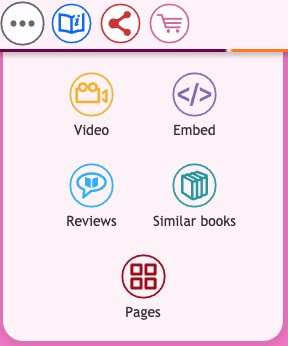
Use the B2L navigation (three dots, upper left) select the Embed option to add a widget to your site. There are multiple options for embedding.
​
  • URL. The complete URL is provided so that the link to the book can be inserted in a webpage. You can link it or put it behind a button on your website​.
LOOK INSIDE THE BOOK
Picture
  • Double Page. This widget is by all means the biggest widget of the entire set and does a perfect job to have an actual impression of the real book or just too simply read a few paragraphs and then want more. We've used a double page in the examples previously provided for Symphony for the Man and Australian Gin. 
  • Single Page. This type of widget means exactly what it says. It’s the same Biblet but viewed per single page since some people do prefer to read/view this way.
  • Icon Embed tag. This is B2L's smallest widget, also known as the Look Inside icon. Typically found on e-commerce websites. On clicking on this widget the Biblet opens (in a new browser tab). Example below.
  • Widget Embed tag. B2L say it's perfect to embed on your website for, let's say, a book review. Example below. 

Book2Look widgets are available through Thorpe-Bowker/My Identifiers and Nielsen. And of course RM Marketing Services offer them as part of a marketing campaign. Buying a single biblet through the bibliographic agencies can be pricey (pending special offers from time to time) so we buy in bulk for our clients to bring the cost down. Another reason to consider using RM Marketing Services for marketing, publicity and promotional campaigns. Contact us today.
0 Comments

Trip down memory lane

30/10/2018

0 Comments

 
Recently I was asked to do a presentation at UTS to a delegation of Chinese publishers on digital disruption in the Australian book industry in marketing and distribution. The organiser asked me to include some of the changes to publishing and distribution I've seen in the nearly three decades I've worked in the trade. When I was talking there were smiles as I summarised bits and pieces - now and then and the here and now - so I thought I'd share on the blog ... 

Picture
Picture
There is no doubt whatsoever that technology has changed what we do, why we do it, how we do it. Digital is part of the every day and it’s hard to imagine life without the internet, apps, mobile devices etc. So to begin let’s wind the clock back three decades. What does Australian publishing look like?
​
The bulk of titles, at least for the major and second tier publishers, were imported from UK and/or US head office distribution centres who had a strong say on what was purchased for the ANZ market. Local publishing programs existed particularly in educational publishing, and publishers distributed their titles through their own warehouse, often attached to their building. Orders were phoned, faxed (faxes had recently arrived in the workplace!) and mailed through to customer service, reps took orders when they called on booksellers or at the annual book fair which alternated between Sydney and Melbourne. Basic Bibliographic data was entered into distribution systems manually so orders could be keyed by data entry staff. Price and availability enquiries were predominantly done via the phone lines. Wait times could be long at busy periods.

With regards to inventory: Buying in titles from overseas was done via catalogue information, published twice a year, with titles six months ahead of publication, and metadata which may or may not have been correct at the time of printing, rights information would always change. Textbooks were expensive (which has never changed) so academic publishers like Maxwell Macmillan where I first started my career would have an International Student edition printed, primarily out of Singapore, on cheaper paper and at a much cheaper price for students. We could price the books whatever we wanted to, marked up high for own margins. There was no goods and services tax. We would airfreight in a small number of copies for reps and marketing & publicity and the bulk came through ocean freight. It would take at least 3 months from the UK and 2 months from the US. If booksellers didn’t place their orders in a timely manner, they would not receive them for months unless they paid a special surcharge for us to air in. Orders to warehouses overseas were done every few weeks to consolidate. Everyone waited for their books. We were the only place they could get them. It was the norm. 

With regards to marketing: Marketing was much simpler. We did A LOT OF MAILINGS! There was one computer for marketing staff who had to book it in advance in order to create price lists and order forms in Wordperfect. We often only had US marketing materials and naturally Australian booksellers wanted to have prices in AUD. Design departments would also grow with graphic designers using Apple’s Pagemaker and they would create promotional materials for us. Four colour printing for marketing was unheard of. We often used the photocopier and may have even used colour paper to make something look more presentable. By the late 90s we could sent to a printer using 1 colour ink. That was very exciting.

As there was of course no internet, we worked off US catalogues sometimes we wouldn’t find out we didn’t have the rights to sell a book in our region for months after we would take it to market – finding out only when we chased supply with our international warehouses or if a bookseller phoned us to say they had seen the same title from another publisher. 

Review copies with media releases were posted out extensively. Sometimes you even used the fax to send out media alerts. You often didn’t know when something was reviewed unless a bookseller mentioned it on the phone to customer service or you heard or watched it firsthand. We paid clipping services - an expensive service that would scan the print media and send clippings of all the reviews. They were like gold in your hand.

Fast forward three decades to now....

Picture
It is rare for a publisher to do its own distribution unless you are one of the majors and you offer third party services to keep costs down and make some money from a competitor. Many publishers use a larger distribution centre and their software and workflows to manage their inventory. New title workflows vary between publishers but there will always be a trade release date for the majors so third party publishers have to make sure they have their stock in, inline with the release schedule. There are KPIs, there are penalties, and there are very real costs for storage of books, orders and returns. Every transaction has a fee. Large print runs are not normal except for first tier authors due to cost, space and risk. Printers turn around requests quickly – there is option for short runs and of course Print on Demand. Nielsen BookScan provides data to publishers on what books are selling through the registers at the bookstores and other channels. Publishers can better forecast when to press the reprint button. Technology and the information it provides has helped with inventory management and competitor information. It has also provided solutions.

You want to read the winner of the Booker prize which has just been announced on Twitter. Can’t access the print book? There is the option of immediately downloading the ebook when you purchase through Amazon, Apple, Kobo or see if it is available to borrow through your library through platforms like Overdrive, BorrowBox, Axis360. These digital suppliers are available via the web from your computer or through a handy app on your mobile device of choice. If it’s a scholarly book you would be looking for access through your university library. YOU expect access through the university library. And yes, you can now access etextbooks through vendors like Proquest and their Ebook Central Platform.

Publishers will either do their own distribution of ebooks and upload them to multiple sales partners directly via FTP or will outsource this to other providers. Ingram for example plays a core role in both ebook distribution as well as some of the larger print distribution warehouses like IPG in the US.

Many publishers have thriving local publishing programs. They make the decision locally as to what to import from their overseas offices and often do a local print run or format change rather than freighting books in – in this market we prefer trade paperbacks over the hardcovers for example. More often than not there are global release dates. Distributors of other publishers products release a month later when airfreight stock come in however others books that are not time sensitive still have a two month delay for their ocean freight to arrive to keep costs down. However they will have gone to market already with that title and have had some copies aired in. 

Orders from booksellers are sent via edi. Others are scanned and sent via email. Faxes still exist but many publishers don’t have one anymore, but the distributors do they have to for the older booksellers who still use them. Key accounts will have electronic workflows so they receive edi notifications, electronic invoices, advance shipping notices, credits, statements etc. 

Pricing of books has changed. The majority are overseas price converted plus GST (no markup as the customer will know – the customer is very savvy – the customer has the internet), some prices may even be cheaper than overseas however that presents problems for textbook publishers in particular who have a re-exportation issues which I won’t go into here.

Price and availability is only a phone call to a distributor as a last resort. Your first point of call as a bookseller is Titlepage – the web based APA initiative that has about 80% of the industry onboard. If booksellers can’t find it on Titlepage they will then open up Baker & Taylor’s database or Ingram’s ipage. You then Google it to try and find the publisher directly. There are still calls to distribution call centres but most of the correspondence they receive is via email, particularly re order management so there is a written trail of correspondence and requests from customers. 

Booksellers don’t expect to wait for books. Ironically they can get overseas published books faster from the overseas wholesalers than from a local distributor. The way booksellers order has changed – smaller copies more frequently and of course expecting the publisher to have a consistent flow of stock to meet demand. They know they lost many consumers to Amazon and The Book Depository years ago so those booksellers who are still standing, and even thriving particularly independents and online, have to provide a high level of service locally for those that appreciate service above cost. It’s been estimated over many years that the Australian book market has lost between $200-300 million in sales to Amazon etc. I think it's more.

Bibliographic data is comprehensive. ONIX is the standard for disseminating that information. Nielsen and Bowker have core roles to play with title data and of course Nielsen has BookScan which has revolutionised the way publishers receive information about the sell-thru of their titles and those of their competitors. Salesforce and other CRMs keep tabs on customers and business development opportunities. For those that require training on resources or who are very remote there is the option of Webex or Skype for Business etc.

These days It’s about search and discovery. And the internet. And SEO. Don’t include an image and customers think it’s not available. No description. Customers will move on. Even the way publishers design their cover images has changed. They have to imagine how the cover looks like on the web and how to make it attractive (white covers are not practical unless they have interesting borders for example).

Pricing. Consumers are pricing savvy. They know how to search for cheap books. Booko for example will collate information from the web and show them the prices offered by online booksellers and chains.

So speed to market is critical. Competitive pricing and service are essential. These cost money but margins are being reduced on all sides in order to give the consumer what they want. What they demand. As without the customers everyone wouldn’t exist.

Marketing has changed dramatically. Database marketing and analytics mean we know more about the customer better from their online activities. We know what they read, what they click through to, what they purchase. At least online. We have Google Alerts and Google Analytics. We have Google fullstop!

Print promotional materials, particularly catalogues are less in demand, postage costs have almost disappeared as marketers have moved to email marketing. Marketing systems like Mailchimp, Marketo, Campaign Monitor, Constant Contact help profile customers and link into other systems effectively for better analytics. They are also free to a point. We have social media opportunities to explore all sides of publishing – Twitter, Facebook, Instagram, YouTube, Pinterest and others present different channels for sharing content, ideas and engagement – with authors, with consumers, with customers. Authors and author branding have become key in this online world as has genre marketing – sci-fi, romance and of course the big one YA.

Event marketing, writers festivals, conferences have provided more avenues to reach both an existing and potential customer base. With the rise and rise of Print on Demand and better options for short run printing, publishers can produce Advance Reading Copies, often unedited, to get booksellers and reviewers engaged early. For those that prefer ebook over print there is NetGalley. Get them talking about forthcoming books using new channels and sites like GoodReads. Create a buzz. Hashtag. #itsallaboutthebuzz

And when I say get “them” talking. I’m not talking about traditional book reviewers. The space in mainstream media for book reviewers has decreased. Literary editors predominantly review only books from the major publishers, with whom they have a direct relationship with their publicists. It’s the Instagrammers, The YouTubers “vloggers” that have social media influence and tens of thousands if not hundreds of thousands of followers who note their book recommendations. This is particularly strong in YA. 

And of course we have multiple formats of products – print, ebook, online, app. Digital has presented many opportunities to exploit content. And marketing has had to accommodate in all the different channels and vendor partners to support sales and product development. Print and promotional marketing still has a role but it is digital marketing has seen the most investment and focus from publishers. ​​
0 Comments

    Author

    Rachael McDiarmid has been in the Australasian book trade since 1990. Working in trade, academic and professional publishing as well as library supply and book distribution, she's worked with thousands of publishers, distributors, library vendors, and authors around the globe. She loves a belly laugh, strong coffee, wine, and good food. Venice is her favourite place in the world to visit but Sydney will always be home. She loves her office assistant Dash (also known as Dashie, Dashie Dog and the Little Shit). If you haven't already worked it out, she is known for her no bullshit approach. 

    Archives

    August 2025
    July 2025
    June 2025
    September 2024
    August 2024
    July 2024
    October 2023
    June 2023
    August 2022
    April 2021
    November 2020
    October 2020
    September 2020
    June 2020
    April 2020
    November 2019
    October 2019
    July 2019
    October 2018
    April 2018
    January 2018
    December 2017
    November 2017
    October 2017
    April 2014

    Categories

    All
    Academic Libraries
    Academic Library Supply
    Adobe
    Adobe Creative Cloud
    AI
    Artificial Intelligence
    Australian Book Industry
    Australian Distribution
    Australian Gin
    Australian Publishing Industry
    Author
    Author Care
    Author Tips
    B2L
    Badges
    Balanced Curve
    Ben Randall
    Bibliographic Data
    Book
    Book2Look
    Book Industry
    Book Launches
    Book Marketing
    Book Promotion
    Book Review
    Booksellers
    Books + Publishing
    Business Books
    Campaign Management
    Case Study
    ChatGPT
    Client
    Coaching
    Coaching Services
    Communication Skills
    Conflict Management
    Consult
    Consulting Services
    Content Acquisition
    David Box
    Design
    Designer
    Digital Content
    Digital Marketing
    Direct Marketing
    Direct Selling
    Distribution
    EBL
    Ebooks
    Ebrary
    Editing
    Endorsements
    Etextbooks
    Events
    Every Stranger's Eyes
    Flyers
    Google
    Graphic Designer
    How To Market Books
    Independent Publishing
    Indie Authors
    Indie Publishing
    Internet
    Introduction
    Inventory
    Libraries
    Library Supply
    LinkedIn
    Local Publishing
    Major Street Publishing
    Marketing
    Marketing Solutions
    Market Research
    Mark Rosenberg
    Mastering Hard Conversations
    Media
    Media Release
    Mediation
    Mentoring
    Micro Publishers
    My Identifiers
    MyiLibrary
    New Book Information
    Nielsen
    Online Marketing
    Online Marketing For Busy Authors
    Operations
    OTJ
    Outsourcing
    Outsourcing Solutions
    Photoshop
    Portfolio
    Posters
    Project Management
    Promotional Material
    Promotions
    Proofreading
    Proquest
    Publicity
    Publisher Relations
    Publishing
    Publishing Industry
    Rachael McDiarmid
    Recommendations
    Review
    RM Marketing Services
    Sales
    Sales Material
    Self Promotion
    Self-Promotion Without Social Media
    Selling
    Sisters For Sale
    Small Press
    Social Media
    Social Media Strategy
    Special Accounts
    Supplier
    Supply Chain
    Thorpe-Bowker
    Time Management
    Tips And Tricks
    Training
    Website Management
    Wholesaler
    Writing

    RSS Feed

Highlights

"Rachael is, quite simply, a book industry genius."

— Franscois McHardy, Former Managing Director, Simon & Schuster Australia

"I thoroughly recommend her for her insights and intelligent analysis."

— Terri-Ann White, Director, Upsell Publishing & Former Director, UWA Publishing

"I can thoroughly recommend RM Marketing Services and their range of services, from campaign execution to strategic consultancy."

— Eleanor Pike, Global Marketing Director, McGraw Hill 

for more recommendations please go to LinkedIn
  • Home
  • Ideas for Publishers
  • Blog
  • About us
  • Contact us